

If you suspect you have bed bugs, they need to be identified before you spend money on a treatment or start moving furniture from room to room. Given we have fought bed bugs for years, we know what separates a useful photo or specimen from a picture nobody can judge.
The EPA makes the point we make on our calls every week: bites alone are a poor indicator. Start with physical evidence, ideally a collected bug found near where someone sleeps.
Do Bites Prove You Have Bed Bugs?
While looking out for bed bugs, it is important to understand that bites are the weakest evidence of all. Despite regularly being blamed on bed bugs, bites from mosquitoes, fleas, and several skin conditions can be easily mistaken for one another on their physical appearance. How a person reacts to a bite depends on numerous factors as well; some people show no visible reaction at all, while others react days after being bitten.
Redness may be less obvious on darker skin. Bite color, lines and clusters cannot confirm bed bugs on any skin tone. Instead of counting bites, look for common signs of their presence, such as:
- Stains appearing in your bedding that look like a rust stain. These can be caused by bed bugs being crushed as you move around during the evening.
- Dark spots that look like someone has had a pen burst on the bedding. These can be excrement from the bed bugs.
- Signs of eggshells and shed casings. These will be tiny and almost invisible individually but become much easier to see in groups.
Focusing on the above signs will be much easier than trying to read a bite pattern. A specimen or several signs found together gives an inspector more to work with than a mark on the skin.
What Do Bed Bugs Look Like At Each Stage?
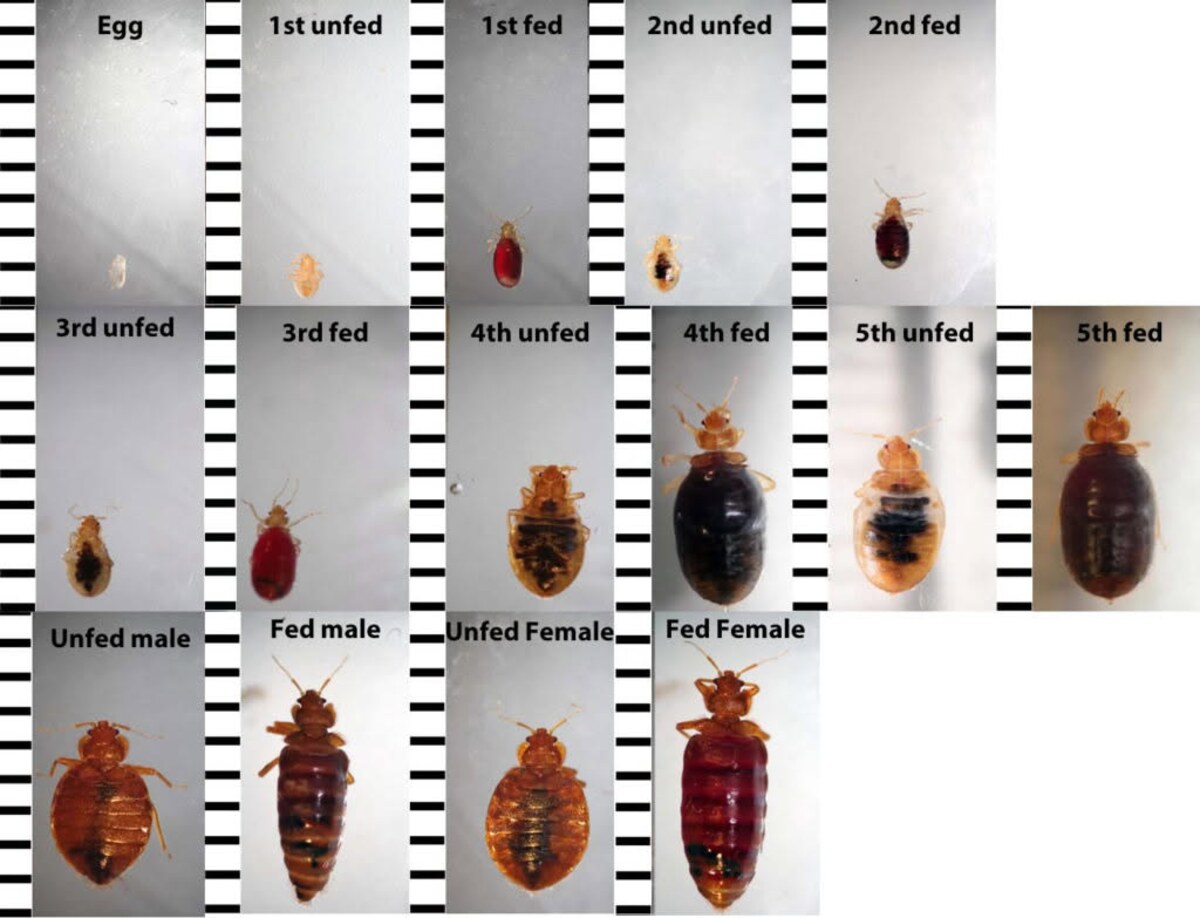
One problem you will notice when comparing your photo against bed bug pictures online is that these pests seem to change color. In some photos, they appear in that reddish-brown hue most of us expect to see. Other times, though, they can be more tan in color or even close to translucent. The smaller, paler ones are nymphs. After feeding, the blood can be seen through their bodies.
Bed bugs begin their life as milky white, grain-like eggs that measure about a millimeter long, and females choose crevices and cracks to lay them in. Smaller bed bugs are much harder to pick up with the human eye. Fully-grown adults, though, are visible to the eye and can be photographed.
| Life stage | Length |
|---|---|
| Egg | 1 mm |
| First-stage nymph | 1.5 mm |
| Second-stage nymph | 2 mm |
| Third-stage nymph | 2.5 mm |
| Fourth-stage nymph | 3 mm |
| Fifth-stage nymph | 4.5 mm |
| Adult | 5–7 mm |
These measurements come from the EPA’s appearance and life-cycle guide. An unfed adult is flat and oval; after feeding, it is more swollen and elongated. Bed bugs cannot fly or jump.
Nymphs have to molt five times before they become fully developed adults. Each stage needs at least one blood meal before the next molt; a bug can feed more than once between molts. The table gives a scale reference, not a diagnosis from size alone.
What Should You Look For Around The Bug?
Bed bugs stay close to ‘home’ – your bed – and are usually found near piping sections and tags on your mattress. Any cracks within your bed frame or headboard, too, could be a place for them to hide. In heavier infestations, bed bugs can be found in the seams of chairs and upholstery, so couches and recliners deserve the same close look. The University of Florida’s identification page lists the same core signs we check on an inspection: the bugs themselves, eggs, excrement, and blood spotting.
Cornell’s pest management program notes that a damp white tissue wiped across a suspected spot may pick up a rusty smear. Treat that as a reason to keep searching the same seam rather than as proof on its own.
As bed bugs age from being a nymph into an adult, they leave behind their old casings, and they continue to do this until they reach full growth. The casings will almost look like old, dead bed bugs until you inspect them close-up, and they are well worth photographing where they lie. Old skins or stains alone do not tell you whether bed bugs are still there or whether their numbers are growing.
How Do You Take A Photo We Can Actually Use?
Taking a useful photo is not as challenging as it might initially sound. Don’t worry; you do not need any special camera equipment! What you will need to do, though, is get the camera as close to the insect as it will still focus, from directly above, in decent light. Digital zoom tends to smear the very details an inspector needs, so moving the phone closer always beats zooming in. Remember that even an adult bed bug is only around 1/5 of an inch in size – laying a coin or a ruler beside it saves everyone a lot of guesswork.
Look at the photo you have just taken, and you should be able to spot how flat and oval the body is. If you cannot make that out, we will not be able to either. Then take one wider shot showing the seam, crack, or piece of furniture where you found it, because where a bug turns up matters nearly as much as what it looks like.
Another thing worth doing, if you can manage it, is keeping the insect itself. An identification can be defeated by simple physical factors – being stepped on, crushed, or swept away – so try to trap the insect in a small container that closes securely. Sealed up like that, the bug will usually dehydrate and die on its own, and the body shape an expert needs to see stays intact.
What Trips People Up When Identifying Bed Bugs?
Several other creatures can easily be mistaken for a bed bug. Getting the identification wrong is how people end up paying for a treatment they did not need. A flea can jump; a bed bug cannot. The closest look-alike is a bat bug, and separating those two honestly takes magnification. This is the situation where a sealed specimen earns its keep.
The table separates adult carpet beetles from their larvae. The adult’s appearance and ability to fly do not belong with the larva’s fabric-feeding habit.
| Pest / stage | What to look for | Useful distinction |
|---|---|---|
| Adult bed bug | Flat, broad oval before feeding; reddish-brown; six legs. | Crawls; cannot fly or jump. Feeds on blood. |
| Flea | Narrow when viewed from above; flattened from side to side; six legs. | Can jump. Feeds on blood. |
| Tick | Shape varies by species and feeding; adults and nymphs have eight legs. | Larvae have six legs. Feeding ticks can remain attached to skin. |
| Adult carpet beetle | Small, rounded or oval; black or mottled, depending on species; six legs. | Can fly. Adults feed on pollen and nectar, not fabrics. |
| Carpet beetle larva | Longer, hairy or bristly body, unlike a flat bed bug. | Larvae can damage wool, silk, fur and other animal-derived materials. |
| Cockroach nymph | Often elongated, with long antennae; six legs. | Does not feed on blood. Appearance varies by species. |
| Bat bug | Very similar to a bed bug to the naked eye. | Needs magnified identification. Tell the inspector if bats are present. |
Sources: EPA look-alike references, UC IPM’s adult/larval carpet-beetle guide and Cornell’s bed bug and bat bug comparison. These are screening clues; keep a specimen when the distinction is unclear.
When Do You Have Enough To Call?
If you have a clear photo or a sealed specimen from a bed seam, frame joint, or piece of upholstery, it is time to call for help with the identification. The same goes for several of the signs above found together in one protected spot. If bites are all you have, start with a proper physical search instead of assuming the answer – you can work through our Florida bed bug checking guide room by room.
Keep suspect laundry in sealed bags before carrying it through the home. Heat-drying suitable items and vacuuming can reduce the numbers, but do not confirm what pest you have or replace a treatment plan. Follow the fabric instructions and the crew’s pre-treatment checklist, rather than moving everything out of the room.
BBE’s inspection costs $200, credited toward treatment. Our treatment uses heat combined with a residual chemical treatment. For a free phone consultation and an exact quote over the phone today, contact BBE or call (727) 591-4417.
Sources Used for This Guide
- U.S. Environmental Protection Agency: How to Find Bed Bugs
- U.S. Environmental Protection Agency: Appearance and Life Cycle
- U.S. Environmental Protection Agency: DIY Control and Containment
- CDC DPDx: Bed Bugs
- Cornell Integrated Pest Management: Identifying Bed Bugs
- University of Florida IFAS: Bed Bug Identification
- UC Integrated Pest Management: Carpet Beetles
From our recorded calls
These are real calls. The answers are word for word. The questions are our summary of what was asked, because callers do not record as clearly as we do. We never publish a caller's surname, address, phone number or price.
How close should a photo of a suspected bed bug be?
I don't need a picture of your ceiling. I need pictures of the bugs as close and clear as you can get them. If you think it's close up and clear enough, I need it even closer and clearer, okay? Because we have to enlarge it because the bugs, the biggest ones are no bigger than an apple seed.
Answered by Dori on a call,