

We serve communities across Florida, such as Wesley Chapel, Largo, Winter Park, and Hudson, and Maryland, including Rockville, Bethesda, and Silver Spring, using a proven combination of thermal heat and a residual spray.
What Temperature Kills Bed Bugs?
The heat, the timing, and why there has to be nowhere left to hide. Here are the real numbers from published research, and how our crews bring a home to a lethal, even temperature in every last corner.
If you have found bed bugs in your home, then one of the very first things you are probably wondering is fairly simple. How hot does it actually need to get to kill them off, and how long do they have to sit in that heat before they are properly gone? It is a good thing to wonder about, and it is a question we get asked just about every day, so we would like to take our time and go through the whole of it with you here.
The short version is that heat really does kill bed bugs, and it kills every one of them, from the eggs right through to the fully grown adults, as long as two things are true at the same time. The air has to get hot enough, and it has to stay that hot for long enough. Those two things go hand in hand, and you cannot really have the one without the other. At around 113°F, which is 45°C, a bed bug will die in the end, but you are looking at somewhere in the region of an hour and a half of steady heat before the grown ones give up, and the eggs are far more stubborn than that, holding on for seven hours or more. Warm the room a little further, up to about 118°F, and the adults are gone in roughly twenty minutes, though the eggs still want a good hour or so. Once you get the air all the way up to 122°F, which is 50°C, there is nowhere left for them to go, and every stage of the insect dies within ten minutes.
Why Does It Take So Long?
People are often quite surprised to hear that a heat treatment is not instant, and we do understand why. You would think that once a room feels hot, the job must surely be finished, but a house is a big and slow thing to heat all the way through. The air in the middle of a room comes up to temperature quickly enough, and that part is easy. The heat then has a lot of work left to do before it reaches the places that actually matter. It has to soak into the mattress, and down behind the baseboards, and into the stuffing of the couch, and right into the middle of every packed box and every folded pile of washing on the floor. The people who study this properly have gone into real homes and measured it, and what they found is that the temperature indoors comes up only very gradually, a small fraction of a degree in a minute and no faster than that. So please do be a little careful of anyone who promises you a heat treatment that is over and done inside twenty minutes, because that is simply not the way heat behaves in a real, lived-in home.
The eggs are the part that tends to catch people out. A bed bug egg can sit through a level of heat that would finish off a grown bed bug in a matter of minutes, which is why we never treat only for the adults we happen to be able to see. If a treatment kills every adult in the house but leaves the eggs behind, then in a week or two you are more or less back where you started, with a fresh batch hatching out. The whole point of doing this properly is to reach the eggs, and reaching the eggs is genuinely the hard part of the job.
The Temperatures And Times That Actually Kill Bed Bugs
The figures below come from university research rather than from us, and we are glad to say they line up closely with what we see out on real jobs. We have laid them out in full, because we think it helps to see for yourself why simply warming a place up is not at all the same thing as a treatment that truly works.
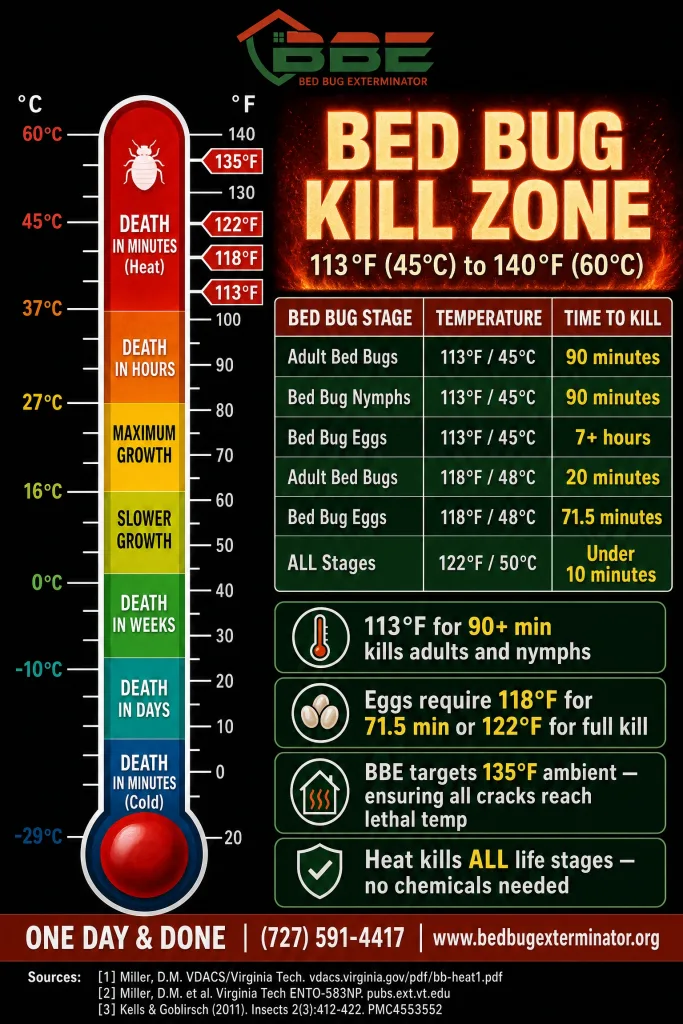
| Life stage | Temperature | Time to kill |
|---|---|---|
| Adult bed bugs | 113°F / 45°C | 90 minutes |
| Nymphs (young bed bugs) | 113°F / 45°C | 90 minutes |
| Eggs | 113°F / 45°C | 7+ hours |
| Adult bed bugs | 118°F / 48°C | 20 minutes |
| Eggs | 118°F / 48°C | 71.5 minutes |
| All stages | 122°F / 50°C | Under 10 minutes |
The researchers who worked all of this out put it fairly plainly. They recommend, for a whole-room heat treatment, holding the air at 48°C, which is about 118°F, for 71.5 minutes, or carrying on until everything has passed 50°C, which is 122°F. What the table really shows, when you sit with it for a moment, is that the eggs set the bar for the whole job. If a treatment cannot hold a temperature that reliably kills the eggs, then it has not really finished, however many grown bed bugs it happened to kill along the way. That is also why we do not aim for the bare minimum temperature. We would rather hold the air at somewhere around 135°F right through the home. That gives us a comfortable cushion of extra heat above the point where bed bugs die off. It also gives the heat the time it needs to soak properly into the mattress, the furniture and the cracks, instead of just warming up the open air in the middle of the room, where very little is hiding anyway.
Why Some Homes Heat Faster Than Others
One of the things we have learned over the years is that no two homes heat the same way, and a big part of judging a job well is reading a home before we ever switch anything on. Two houses of exactly the same square footage can behave very differently, and here are the things that actually move the needle.
How well the home holds heat. This one works in our favor more often than not, which surprises people. A newer, well-insulated home with good, tight, double-glazed windows is genuinely easier for us, because once we put the heat in, the walls and the windows hold onto it and the temperature climbs steadily and stays put. An older home with thin walls, gaps around the doors, and single-pane windows leaks heat the whole time we are working, a bit like trying to fill a bath with the plug half out. We can absolutely still treat it, and we do, all the time, but it takes more heat and a little more patience to hold the home at temperature.
How much is in the house. This is the big one, and it is the part homeowners have the most say over. Every single thing in your home, the furniture, the clothing, the boxes in the closet, the books on the shelves, all of it has to come up to temperature along with the air, and all of it soaks up heat before the room can hold steady. A sparse, tidy home might reach a killing temperature in a couple of hours. A home packed wall to wall with belongings can take a good deal longer, because there is simply so much more for the heat to work into. This is the honest reason we ask you to thin things out for us, and we will come back to it just below.
The weather outside. We work across Florida and Maryland, and the day’s weather genuinely matters. A treatment on a warm, still afternoon has a head start, because the house is already warm and the heat we add does not have far to climb. A cold, breezy winter morning is harder work, since the outdoors is pulling heat out through every wall and window while we are pushing it in. It is the same reason a house is easy to keep warm in summer and stubborn in the depth of winter. None of this stops us, but it is why our crews plan the longer, colder jobs a little differently.
Humidity and moisture. There is a smaller factor worth a mention, which is the moisture in the air and in the contents of the home, because damp things hold on to a lower temperature longer than dry things do and are slower to bring up to heat. It is a modest effect next to insulation and clutter, but it is a real one, and it is one more reason we watch our readings all the way through rather than trusting that the job is finished the moment the air feels hot.
Why There Must Be Nowhere Left To Hide
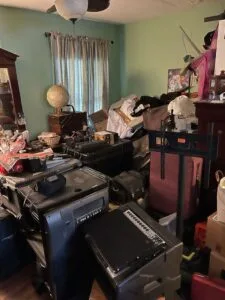
Here is the part that matters every bit as much as the numbers, and it is the part a rented heater from the hardware store can never quite manage. A bed bug does not have to survive the heat out in the open. It only has to find one small spot that never quite gets hot enough, and quietly wait the whole thing out. That spot might be the very middle of a tightly packed storage box, or the cool core of a big pile of laundry left on the floor, or the back of a closet that is crammed so full the warm air simply cannot work its way in. Those piles act rather like insulation. The outside gets nice and hot while the middle stays cool, and that cool middle is precisely where a bed bug will tuck itself away and ride the treatment out.
This is why we ask for a little help from you before we arrive, and it really is a simple thing to ask. We would like you to thin the house out a bit for us. We are not asking you to empty the place, and you do not need to bag everything up or carry it off somewhere. We would just like the clutter brought down, so that there are no enormous solid piles of anything, and so the closets are loosened up rather than jammed to bursting. The more your things are spread out and opened up, the more easily the hot air, and the moving air we push around the place with it, can get to every last surface. A room that has been thinned out for us will heat through nicely and evenly, whereas one that is packed up to the ceiling tends to fight us the whole way through, and worse than that, it leaves the bugs a cool spot to sit the treatment out.
Why Moving Air Matters As Much As Heat
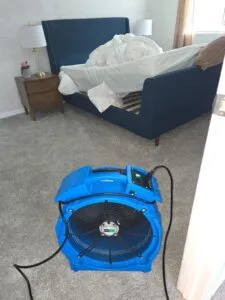
Getting a house hot is honestly only part of the work. The harder part, and it is where a good many so-called heat treatments fall down, is getting the house hot evenly, so that every corner reaches the same temperature at more or less the same time. Heat that is simply left to sit will drift up and gather near the ceiling, and it leaves cooler pockets down low and along the corners and the skirting boards, which are the very places a bed bug likes to settle into. Heat on its own, in other words, does not really finish the job, and the air in the home has to be kept moving, quite a lot of it.
When you ask our service technicians what really makes the difference, they do not hesitate over it. Chase, Richard, and Victor will all tell you the same thing, that it comes down to getting the air moving. Heat that just sits there is not much use to anybody, and you need equal temperatures all through the house, and the only way to get that is to move a great deal of air and to keep on moving it. We use high-velocity industrial fans for this, the B4E50K2M72391 multi fans, which are proper industrial-grade machines rather than anything you would keep around a house, and we run them to really push the hot air around. What we are trying to build, and our guys will say this to you plainly, is a tornado of heat, circulating the hot air right through the home so the temperature is even everywhere and there is simply nowhere left for a bed bug to hide away from it.
This is also where our Heat Assault system quietly shows its worth. It is built to bring the heat up uniformly, so the whole home reaches temperature together and then holds there, rather than one room baking away while the room next door lags behind. Equal temperatures right through the home, applied evenly and everywhere at once, is the whole thing we are working toward, and in all honesty it is a difficult result to reach any other way. The combination of our residual spray and the Heat Assault heat is, we will say it plainly, the best one-day-and-done treatment available, and it is what our technicians stand behind.
How We Know Every Corner Actually Got Hot Enough
All of this talk of temperature would not mean very much if we were only guessing at it, and this is a part of the work we take quite seriously, so we would like to explain how we keep track of the heat once a treatment is underway. We do not simply set the equipment going and hope for the best. We watch the temperature the entire time, in a good many places at once, because the whole job rests on knowing that every last corner of the home has truly reached a killing temperature and held there.
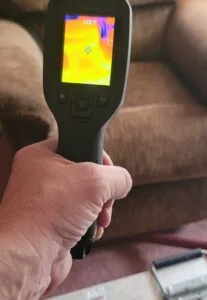
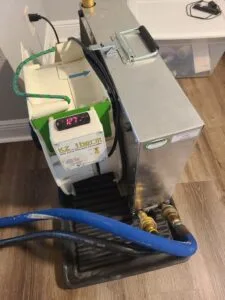
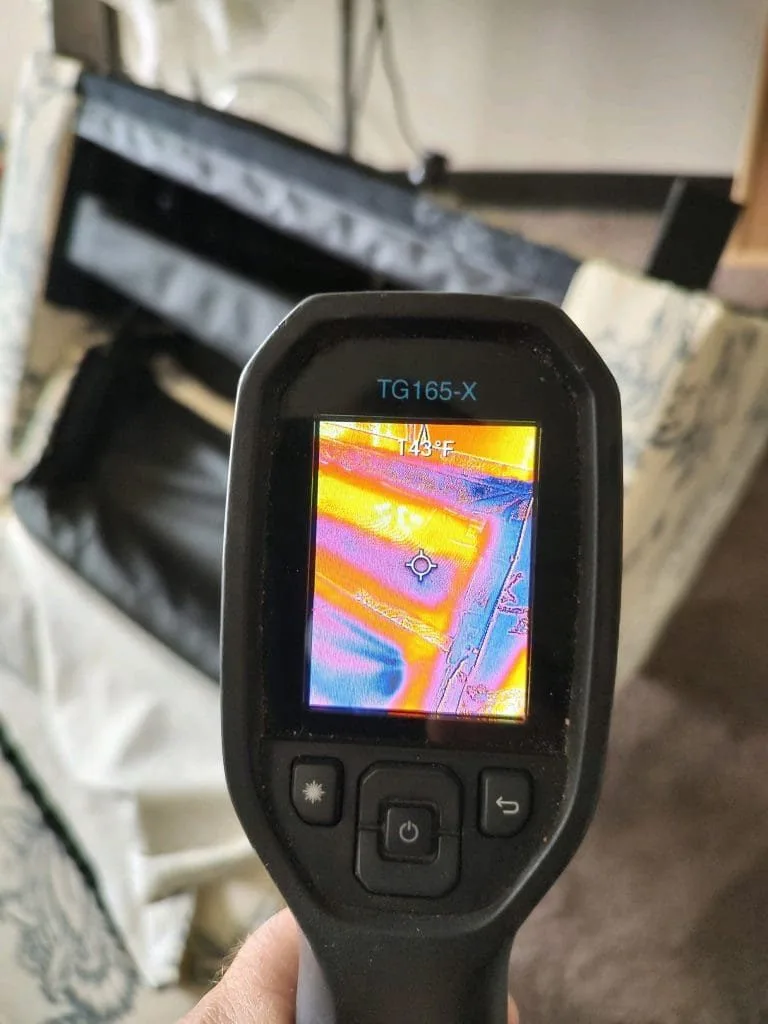
To begin with, each of our heaters has its own thermostat built into it, so the units themselves are reading and holding their temperature as they run, rather than being left to blast away blindly. That is the baseline. On top of that, we go around the home with thermal imaging cameras, the same sort of professional heat cameras the fire service and the building trades rely on, and the two we run are the FLIR E8-XT and the top-of-the-line FLIR E96. If you have not seen one used, a thermal camera lets us actually see the heat, so a cool spot that a thermometer in the middle of the room would never catch shows up plainly on the screen as a darker patch.
We use those cameras to check everywhere, and we mean everywhere. Every corner of every room, along the baseboards, up the walls, behind and underneath the furniture, inside the closets, and all the little tucked-away places where a bed bug might be sheltering from the heat. If the camera shows us a spot that is lagging behind, we know exactly where to move a fan or add more heat, and we stay with it until that spot has come up to temperature along with the rest of the home. Only when the whole place reads hot enough, everywhere we look, do we count that part of the job as done.
Why We Pair The Heat With A Spray
Heat does have one honest limitation, and we would far rather be straight with you about it than pretend otherwise. Once the house cools back down again, the heat is simply gone, and it leaves nothing behind to deal with a stray bed bug that might wander in from somewhere else a few days later. So we do not lean on heat by itself. We pair our Heat Assault thermal treatment with a proprietary residual spray, and the two of them look after different parts of the problem. The heat takes care of the bed bugs and the eggs that are in the home on the day, at every stage of life, and the spray carries on working quietly for weeks afterward, ready to catch anything that slipped through or tries to make its way back. That pairing of the residual spray and the Heat Assault heat is, quite simply, the best one-day-and-done treatment we know how to give you, and it is the reason we are happy to stand behind the result with a guarantee.
Where These Numbers Come From
We would honestly rather show you our working than ask you to take our word for any of this, so the temperature and timing figures above are drawn from published university research and not from our own marketing. If you would like to read the science for yourself, here it is.
- Miller, D.M. — Virginia Department of Agriculture and Consumer Services / Virginia Tech. Bed Bugs and Heat Treatment. (vdacs.virginia.gov/pdf/bb-heat1.pdf)
- Miller, D.M. et al. — Virginia Tech Cooperative Extension, publication ENTO-583NP. (pubs.ext.vt.edu)
- Kells, S.A. & Goblirsch, M.J. (2011). Temperature and Time Requirements for Controlling Bed Bugs (Cimex lectularius) under Commercial Heat Treatment Conditions. Insects, 2(3): 412–422. (PMC4553552)
Dealing With Bed Bugs Now?
If you are looking at bed bugs in your own home and want the heat done properly, with the moving air and the uniform temperatures that actually reach the eggs, we are glad to talk it through with you before you spend anything. Treatment is priced by the size of the home, and you can estimate your price here or read more about our bed bug heat treatment.